
Kilimanjaro & Mount Meru Expedition Report 2026
Mount Meru Phase
Arrival & Preparation
Our team touched down in Tanzania full of anticipation, greeted by warm air and the towering presence of Mount Meru rising above Arusha. We settled into a beautiful hotel nestled beneath the mountain, the perfect base for our final expedition briefing.
We covered the essentials — pacing, hydration, mindset, teamwork — all the foundations for a successful expedition. A last-minute packing session followed before everyone turned in early. Ahead of us stood our first objective: Mount Meru (4,566m), Africa’s fifth-highest peak.

Into Arusha National Park
The following morning, we transferred into Arusha National Park — and within 20 minutes the trip had already delivered a wildlife spectacle. Zebras, giraffes, warthogs and monkeys welcomed us as we made our way to Momella Gate (1,600m).
After completing formalities and enjoying a hot lunch, we began our ascent. The lower slopes of Meru are lush and alive, and our four-hour trek to Miriakamba Hut (2,500m) took us through dense forest teeming with wildlife.
The huts are surprisingly comfortable — four to a room — and above us Meru towered dramatically, a constant reminder of what lay ahead.


Acclimatisation at Saddle Hut
Day three saw us continue climbing steadily through jungle terrain, the team in high spirits and settling into expedition rhythm. As we approached camp, students from a local tourism college welcomed us with beautiful singing — a special cultural moment none of us will forget.
Saddle Hut (3,500m) would be home for two nights as we acclimatised properly. Some of the team even climbed Little Meru as an additional acclimatisation walk. The strategy was simple: take our time, adapt well, and prepare properly for summit day.

Summit Day – Mount Meru (4,566m)
A 3am wake-up call signalled the start of our summit push. Porridge and biscuits fuelled us before we stepped into the darkness.
After 90 minutes we reached Rhino Point (3,800m) just as the sun began to rise — and Kilimanjaro appeared on the horizon in spectacular fashion. A breathtaking sight and a powerful reminder that phase two awaited.
We negotiated “the chains,” protecting an exposed section, before tackling steeper slopes. The team moved brilliantly — steady, strategic, disciplined.
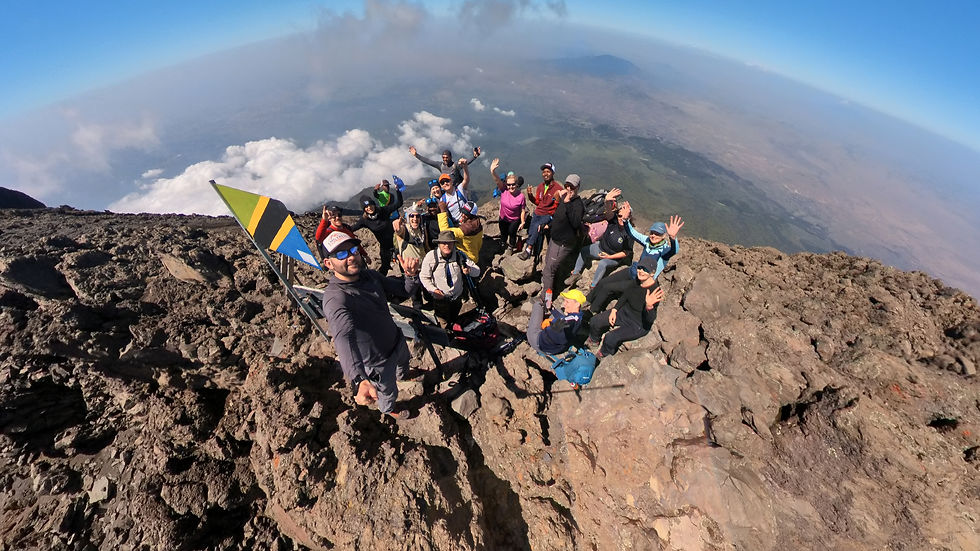
Seven hours after leaving camp, we stood on the summit of Mount Meru — Africa’s 5th highest peak. The views were immense, the sense of achievement even greater.
We descended carefully back to Saddle Hut in around four hours, spending a second night at altitude — a deliberate acclimatisation strategy that would prove invaluable later in the expedition.
Descent & Transition
Our final morning on Meru delivered another magnificent sunrise beyond Kilimanjaro. As we descended through the forest, thicker air and lower altitude lifted spirits further.
Near the valley floor, our ranger took us on a short detour — and we were rewarded beyond expectation. We found ourselves standing almost side-by-side with a small group of giraffes. An unforgettable wildlife encounter and a perfect way to close our time on Meru.
After a 90-minute transfer to our hotel near Moshi, showers, food and a celebratory beer or two were thoroughly enjoyed.
Mount Meru isn’t always included in Kilimanjaro itineraries — but it truly is sensational. Quiet trails, wildlife encounters, a second summit, and superb acclimatisation make it an exceptional addition to any Kili climb.
Kilimanjaro Phase – Machame Route
Back to the Mountain
After a restful night and a big breakfast, we transferred to Machame Gate (1,700m). Four days of trekking stood between us and our summit attempt on Africa’s highest mountain.
The climb began through dense rainforest, five steady hours bringing us to Machame Camp (2,835m). This marked our transition to tent life, supported by an incredible local crew who assembled camp at remarkable speed.
Hot water for “washy washy” was always warmly welcomed — especially as the mountain grew dustier with altitude.

Into the Moorlands
From Machame Camp we climbed approximately 1,000m to Shira Cave Camp. The trails became rockier and steeper, but the team’s attitude remained consistent — heads down, get stuck in, get it done.
We transitioned from rainforest into moorland, and eventually into the more arid alpine desert near the Shira Plateau. Heavy rain arrived that afternoon, but with nowhere to be, we simply stayed dry and drank tea. When the clouds parted later, the mountain delivered spectacular evening views.
Lava Tower & Barranco
The climb to Lava Tower (4,600m) was a key acclimatisation day — “climb high, sleep low.” With Kilimanjaro’s summit looming ahead, we lunched beneath this iconic volcanic feature before descending to Barranco Camp.
The Barranco Wall stood above us — intimidating at first glance, but entirely manageable.
Barranco Wall & Base Camp
The day began with the famous Barranco Wall — 250m of enjoyable scrambling, including the legendary “Kissing Rock.” It’s one of the most memorable features of the Machame Route.
After ascending, descending, and climbing again, we reached Karanga Camp for lunch before pushing onward to Barafu Camp (Base Camp).
Clear skies revealed the steep slopes we would tackle from midnight. After an early dinner, we turned in for what little rest we could manage before the 11pm alarms.

Summit Day – Uhuru Peak (5,895m)
At 11pm the alarms sounded. Porridge and biscuits once again fuelled us as we stepped into the cold, windy night.
Headtorches from multiple teams illuminated the slope above — a surreal and powerful sight.
Summit day on Kilimanjaro is gruelling: 1,200m of ascent at extreme altitude, with biting wind making temperatures feel even colder. Breaks were short and infrequent. The team showed immense resilience — no drama, no fuss, just determination.
Near Stella Point, dawn began to break. The final 45 minutes to Uhuru Peak demanded everything — but shortly after 6:30am, every single member of the team stood on the summit.
The highest freestanding mountain in the world.The tallest mountain in Africa.
We had done it.
Pride doesn’t quite cover it — what an effort, what a team.
The descent back to high camp took 3–4 hours. After a short rest and kit sort, we continued down to Millennium Camp. Exhausted, satisfied, accomplished.
Final Descent
Our final morning on the mountain delivered yet another unforgettable sunrise. Coffee in hand, it was a moment to reflect.
The five-hour descent to Mweka Gate passed quickly, back through rainforest once more. The porters — carrying huge loads — ran past us with smiles, a humbling reminder of their strength.
At the gate, our entire trekking crew sang to us. An emotional and fitting close to the expedition. Without them, none of this would have been possible.
Certificates were collected, and we returned to the hotel for one final evening together before heading home the next day.
Expedition Summary
Over 11 days, the team:
Summited Mount Meru (4,566m)
Summited Kilimanjaro – Uhuru Peak (5,895m)
Witnessed extraordinary wildlife
Experienced multiple ecological zones
Demonstrated resilience, teamwork and outstanding attitude
Yet again, Mount Meru proved to be an exceptional addition — providing quieter trails, wildlife encounters, and invaluable acclimatisation that undoubtedly strengthened our Kilimanjaro summit success.
An unforgettable expedition. An exceptional team. Tanzania at its very best.


Comments